Showing posts with label budget issues. Show all posts

Friday, July 19, 2013

Our war against ourselves

I am utterly confounded by the American people's steadfast refusal to allow any increased tax revenues for libraries, schools and other public services.

The public's willingness to sacrifice its own well-being is frightening to someone who was born in 1950 and raised in an America which viewed civic responsibility as one of its highest secular values.


Hard times or no hard times, this nation has always known in the past that sustaining the literacy, education and health of its people was the only real way to defend national security.

What has happened?

Here are three current Florida library examples of what our county and municipal governments are doing in response to our unwillingness to foot the bill for our own futures.

Jacksonville: Mayor’s budget includes $2.9 million cut to libraries 
Mayor Alvin Brown presented his Fiscal Year 2014 budget to the City Council yesterday. Faced with a $64 million shortfall, departments citywide have been required to take significant cuts.... The library’s budget as submitted...would be $31,420,192. This reflects a reduction of $2,896,659 from the current year, and is $517,801 more than the cut the Administration requested in June.
In order to meet this reduction, the following recommendations submitted by the Board of Library Trustees in June remain as proposed: 
  • No Sunday hours at any location (five locations are currently open on Sundays)
  • A reduction of eight hours of service at the Main Library (down to 40 hours per week)
  • The closure of six branches....
  • These closures and the reduction in hours at the Main Library will result in the elimination of 33 full-time positions
  • The materials budget was cut by $173,370.
Miami-Dade County: Dade Commission Approves Tax Rate For New Budget

Miami-Dade County government may be about to undergo another round of austerity after county commissioners approved by a vote of 8-4 a budget for the new year which does not include an increase in property taxes....

Miami-Dade County Mayor Carlos Alvarez...proposed closing a $50 million shortfall by closing more than 20 library locations and eliminating 250 library workers. The county’s fire rescue service would also take a major hit: 149 fire recue workers would be laid off and six fire units would be taken out of service.
Florida Schools: Media Specialist Role Endangered in Florida

School media specialist positions are being hit hard across the Sunshine State, with school librarians finding their positions renamed— and, in some cases, their jobs reassigned or terminated—for the coming 2013–14 school year.

In the Sarasota County School District, all high school and middle school media specialists have been cut for the 2013–14 school year....
Marion County Public Schools has cut 15 of its 30 elementary school librarian positions for the 2013–14 school year, although 11 of those positions had been vacant owing to a hiring freeze for the last three years....

In Pasco County, the school district has done away with the media specialist role and created a new position called an “information communication technology literacy coach...."

Lynette Mitchell, a library media specialist for the past 22 years, told Hotline that in her district of Citrus County, FL, “teacher on special assignment/media” is the new title, which means the position could now be staffed by a teacher with a media center background....
[Library Hotline, 7/22/2013, pp. 2-3]

School media specialist cuts are also taking place in Jacksonville.

Who is willing to take ownership of the public good? Is anyone?

Addendum: My point exactly—Ron Littlepage's viewpoint column in the 7/19/2013 Florida Times-Union.

I recently received a handwritten letter in response to my column published on July 10 in which I argued that a tax increase was the only way out of the city’s budget and pension mess....

It began “Dear Sir” and ended “Sincerely” followed by the writer’s signature. This is what was in between: “Your column of this date in The Florida Times-Union stinks. You are a tax and spend, tree-hugging environmentalist of the first-class...."

I was curious as to how much he was contibuting in city property taxes....

According to the property appraiser's website, his house has a market value of $155,717.... Because of caps on increases dictated by the Save Our Homes amendment to Florida's Constitution, the assessed value is $74,226. The home also carries homestead exemptions worth $49,226.
That means he paid city taxes on a taxable value of $25,000, or $250.88.
For $250 a year...he gets police and fire protection, libraries, parks, roads and a myriad other city services....

[If] the city tax rate were increased by one mill to fill a $61 million budget hole..., he would have to kick in another $25 a year.  For those complaining about high city taxes while paying next to nothing, I have one word: Humbug!
[emphases added]

Wednesday, September 12, 2012

Black border

Talking with my library colleagues.

Since the economic crash of 2007-08, we in the public libraries have increasingly been dealing with needy customers, unemployed, homeless, etc., who can no longer get government help at any level except through the Internet and email.

The public library is the ONLY walk-in, face-to-face social service agency left.

And now we are being dismantled.

As we learned last Thursday, of the 150 City employees being demoted or laid off for Fiscal Year 2012-13, 75 are in Jacksonville Public Library.

Several of the "survivors" have already announced retirement by the end of the fiscal year. A good number of the bright younger folks who were demoted—some after having promoted within just the past few years into key positions—are looking for jobs elsewhere. This Friday we will find out how the rest of us "civil servants" are being reshuffled among our different locations.

Across our nation, our governments seem not to understand or to care that breaking up long-established teams of skilled human service colleagues is far more expensive, in terms of the blow to productivity, corporate memory, morale and community relationships, than the payroll and benefits dollars they think their personnel cuts will save.

They do not seem to understand or to care how severely these cuts will hit the most vulnerable members of the community (see Digital Refugees), those who depend upon public libraries as their sole access to government services and employment resources, which have been pulled back across the "Internet moat" into the stronghold of the e-technology privileged.

Last public service agency standing...but for how long?

Saturday, July 14, 2012

"Der Hölle Rache kocht in meinem Herzen"

"Hell's vengeance boils in my heart."

Well, actually I don't feel quit that fiery about the current Draconian round of Jacksonville Public Library budget cuts. In fact, I'm too burned out to do much at the moment except bring the bad news to my readers' attention.

Instead, here is Diana Damrau performing the coluratura's worst nightmare from Mozart's Magic Flute.


And, in case that isn't impressive enough, here is fourteen-year-old Robin Schlotz.


Wow!

And finally, the (in)famous Florence Foster Jenkins.


Eek!

Tuesday, June 19, 2012

A Library Book Burning Success Story

Thanks to my colleague, Josh Jubinsky, for this post:

Book burning would get just about anyone’s attention, right?

When a .7% tax increase seems too large a burden for a town, a clever PR campaign saves the day. This should be required watching.


Let everyone you know about this. Let's get the public stirred up FOR libraries.

Tuesday, May 22, 2012

Save the American Community Survey

On May 10th the House voted to defund the 2012 Economic Census and eliminate funding for the American Community Survey.

The American Community Survey (ACS) is an ongoing survey that provides data every year -- giving communities the current information they need to plan investments and services.

Information from the survey generates data that help determine how more than $400 billion in federal and state funds are distributed each year.

The Senate may consider funding on the Commerce, Justice and Science appropriations bill this week.

Online petition of support here:
http://www.petition2congress.com/6825/save-american-community-survey-acs/

Rep. Norman Dicks (Washington), Member of the Appropriations Committee, commented that the ACS was first administered in 2005 under President Bush and includes questions that were part of the long form Census and have been asked since the time of Thomas Jefferson.

Information from this study are used to establish policies about how to distribute over $800 million in federal funds, including Medicaid benefits.
For more in depth information:
A Future Without Key Social and Economic Statistics for the Country, from the blog of Robert M. Groves, Director of the U.S. Census Bureau.

The 2012 Economic Census provides comprehensive information on the health of over 25 million businesses and 1,100 industries. It provides detailed industry and geographic source data for generating quarterly GDP estimates.

The economic census is also the benchmark for measures of productivity, producer prices, and many of the nation’s principal economic indicators. At this moment, we are poised to request the key data from individual firms.

We have already printed 7.5 million forms, and are preparing the October mailing and internet data collection infrastructure. Cancelling the 2012 Economic Census now wastes $226 million already expended on preparatory activities.

Please share this information widely.

Thanks,
Mike

Petition the White House to Open Access to taxpayer-funded research

Note: This message is copied verbatim from a District Dispatch email.


Who:You! And anyone you know who supports libraries and supports increasing access to information - especially research that you (the public) helped fund.

What:
A petition is posted at "We the People" asking the White House to require the published results of taxpayer-funded research be made available via the Internet (without having to pay an additional fee to access the research).

When:
Now! 25,000 signatures must be secured by June 19 to ensure the White House will respond.

Where:Go to wh.gov/6TH electronically sign the petition. It's that easy!

Why:Why not?! The petition asks the White House to build upon the tremendously successful National Institutes of Health (NIH) Public Access Policy implemented more than four years ago and now has 500,000 users accessing and downloading two million articles a day.

But wait, there's more! The petition's request to the White House essentially mirrors active legislation - the Federal Research Public Access Act of 2012 (FRPAA) (S. 2096, H.R. 4004) - that would extend the NIH model to make available taxpayer-funded research of an additional 11 federal departments and agencies! Increased access would allow librarians the ability to better assist patrons with their information and research needs as well as allow direct access by the public.

Please spread the word by forwarding, posting and tweeting (#openaccess), etc.!

Corey Williams
Associate Director, Office of Government Relations
American Library Association

Friday, May 11, 2012

Chuck McClure: "Score 1 (or more) for the Digital Divide and 0 for Florida public libraries"

Dr. Charles R. McClure
Another excellent response to Gov. Scott's veto of Multitype Library Cooperative (MLC) funding from Dr. Charles R. McClure, Director at the FSU Information Institute, this one on the Libraries Connect Communities blog of American Library Association.

Dr. McClure focuses on the veto's negative impact on the collaborative efforts of Florida libraries to help customers, especially in rural counties, to get across the digital divide—this in a time when all of the state's own social services, including unemployment assistance, are now only available online.
We have discussed the digital divide implications between rural and urban/suburban settings noting how rural public libraries struggle to provide adequate broadband and information technology (IT) support. The Public Library Funding and Technology Access Study (PLFTAS) data demonstrate this struggle. Recent events in Florida suggest that strategies to reduce the rural digital divide – or at least the role that libraries can play in reducing that divide – will remain difficult....

While the $1.5 million veto may not sound like much money, the pain likely will be felt disproportionately in rural areas since many of the rural libraries depend on their MLC for a range of IT access, training, and support. As part of this blog, I interviewed a number of Florida public librarians for their assessment of the veto on the digital divide in Florida.
Please read and share the whole blog post.

Sunday, September 4, 2011

The wrong conversation

I think we library professionals have been having the wrong conversation for the past few decades.

We struggle to fund, deliver and market the content and technology we think our users want. We forget that what makes libraries unique among public agencies is the specialized research skills and service orientation of our professional staff.

The first personal computer, Archive for History of Digital CommunicationGranted, libraries are masters at delivering content, and they have always been early adapters of new technologies. We were among the first to explore how computers could be used to label, store and retrieve information in practical and powerful ways for the public. As mobile digital content has become delinked from containers and locations, we have continued to keep up with the changes.

However, library folk tend not to think in terms of owning information, much less marketing it. More to the point, we know that what the public needs from us is not so much the information itself. Libraries provide that no other public agency does, the expertise of professional searchers, human specialists who can do intelligent, probing interviews, determine what the deeper information needs are, and then provide that information, regardless of format, in the ways which best suit the users’ situations.

Public service or marketplace

Our greatest disadvantage is that libraries are usually not profit-making entities. Precisely because we are not, we tend to be at the mercy of funders who have other priorities. This has always been true, of course. In recent decades, though, governments have replaced the public service needs-assessment model for justifying funding with the retail world's narrower, consumer-driven marketing model.

At first glance this seems to make sense. Given the steady decline of public revenue, it is plausible to assume that taxpayers will be more willing to pay for what they believe they want. That notion has led libraries and our public funders to skew our choices more and more in the direction of constantly shifting and difficult to measure "customer satisfaction."

The rationale given for this shift is that libraries are increasingly “in competition” with retail providers of the same “products” we offer. We have, in effect, been reengineering libraries into “free stores,” trying to stock whatever the most savvy—or at least the most demanding—consumers feel they are entitled to.

The “taxpayer revolt”

However, there are some fallacies hidden behind this shift in funding rationale. The first fallacy is that the decline of public funding is recent, due to national economic troubles. In fact, this decline did not begin with the crash of 2008 or the federal tax cuts of 2001. It has actually been accelerating ever since the early 1980s.

Historical reality suggests that the shift is due not simply to a decline in available revenue but to a broad decline in public and political willingness to fund public social services. Beneath the so-called “taxpayer revolt” of recent decades is a drastic change in core national values.

Many Americans seem to have lost their sense of civic responsibility, the conviction that those with at least basic material stability ought to contribute to the welfare of the whole community, regardless of what they need or want personally. This conviction was undergirded in earlier times by an awareness that such civic benevolence helped the givers as much as the receivers.

We now struggle instead under the illusory metaphor of the marketplace, the dystopian notion that we should only have to pay the government for what we want for ourselves. Even those of us who pay little or nothing in taxes tend to believe that any agency which the public funds should deliver whatever we imagine we are “entitled” to get from it, regardless of what that agency’s actual mandate and resources are.

People, not information

The sad truth is that now we are in a drastic, long-term economic decline. It becomes increasingly difficult to convince the public and the politicians to fund services which they were already defunding in boom times. That makes it all the more important to expose the second fallacy about library funding. That fallacy is that libraries can (and should) find ways to provide comparable goods and services with fewer staff people.

In the private sector it is gospel that, when you need to reduce the bottom line, you cut payroll, the most expensive budget category. Since the corporate world is where our culture “learns” about budgetary efficiency, this notion has been imported into the public sector. The key problem is that, in social services, the key ingredient is not “goods and services” but human interaction.

As I suggested at the start, my contention is that libraries are social services. What makes us unique is not information or access to information but, rather, human specialists who can interact professionally yet compassionately with their users, determine what those people’s needs are, and guide them to the information and to effective ways to use it.

People frequently come to us with ill-formed notions about what information will serve their needs, and with ill-informed notions about how to get that information. Human library specialists are essential intermediaries between these users and the whole dizzying 21st century array of “containers” and “media” for information storage and retrieval.

It is not information which we give away at public expense, so much as it is our expert interviews, searches, coaching, instruction—and, most important, human understanding.

The Surly Librarian post to which I linked earlier in this piece was called “It’s the infrastructure, stupid!” My argument here—my argument with both library administrators and with public funders—is that it’s the people, stupid!

Libraries cannot compete with Amazon and Barnes & Noble and Verizon and Google, etc., etc., etc.... I contend that we shouldn’t have to. What we give away that those commercial enterprises cannot sell is quality human interaction.

The Human Library: Check out a person instead of a bookInteraction between expertly trained, caring, patient professionals, people willing to puzzle out—sometimes at great length and in the face of customer frustration and annoyance—what each person who comes to us really needs, and what path to satisfaction of that need she should take, either through our own collections or through the myriad publications, corporations, agencies and online archives to which we can lead them.

I’m not advocating that libraries should stop trying to keep up with the mobile digital revolution.

I am advocating that we should insist—demand—that our public funders recognize that our staff are our product.

If we had no collection at all but still had our staff, we could continue to be a public social service.

Am I crazy, or am I onto something?

Wednesday, June 29, 2011

Tame The Web: "Libraries Aren't Free"

A post by Carrie Straka, quoted in its entirety from Michael Stephen's excellent blog, Tame the Web: Libraries,Technology and People:

Recently,ALA retweeted a tweet that originally came from @FSG_Books. It was a library haiku that read: A library card / is a 100% off / coupon for great books. This is a misconception throughout libraries everywhere.

A library card isn’t a 100% off coupon. A library card is a tool that allows users to take advantage of the services and materials that have already been purchased for them. People who use the library and borrow those books have already paid for them. They’re not free books when the people borrowing them have already paid for them.

Many users believe that the services and materials we provide are free. As all library staff knows,this is a misconception. The services and materials we provide are not free. In fact,they are far from it. Librarians work within a budget and use all money provided to us through taxes, tuition, or other means.

Librarians should be challenging our users’ beliefs about the library every day. Let’s start by challenging the belief that library materials and services are free. When users ask,“Is it free?” or “Is there a charge?”, try responding by saying, “No, your (tax dollars/tuition/company’s expenditures) have already paid for it.”

The Library is America's last truly socialized institution and you're about to lose it, Daily Kos, Feb 28, 2011, illustration by Jason JonesI bet you’ll be greeted by confused looks. I think users forget that they’ve already contributed to the library with their taxes or tuition. We can encourage library usage by showing people that they can take advantage of something they’ve already paid for. [Emphasis added.]
Yep!


Note: Click on the image to see another powerful post from Daily Kos.

Thursday, June 2, 2011

"A Country without Libraries"

"A Country without Libraries" is an important new article by Charles Simic, posted on the NYR Blog (New York Review of Books) on May 18, 2011.

Hartland Four Corners, Vermont, 1994. Robert Dawson’s photos of libraries are currently on view in the exhibition Public Library: An American Commons at the San Francisco Public Library.Here is the opening text:

All across the United States, large and small cities are closing public libraries or curtailing their hours of operations.

Detroit, I read a few days ago, may close all of its branches and Denver half of its own: decisions that will undoubtedly put hundreds of its employees out of work.

When you count the families all over this country who don’t have computers or can’t afford Internet connections and rely on the ones in libraries to look for jobs, the consequences will be even more dire.

People everywhere are unhappy about these closings, and so are mayors making the hard decisions. But with roads and streets left in disrepair, teachers, policemen and firemen being laid off, and politicians in both parties pledging never to raise taxes, no matter what happens to our quality of life, the outlook is bleak.

“The greatest nation on earth,” as we still call ourselves, no longer has the political will to arrest its visible and precipitous decline and save the institutions on which the workings of our democracy depend.
I urge you to read and share the whole blog post.


Thursday, May 5, 2011

Now that we've celebrated, I have to ask....

...why did we have to go through the argument over state library funding again this year?

Last year, library supporters in Florida were put through the same torment when the legislature in Tallahassee threatened to cancel the $21.2 million state funding for public libraries. It took two months and over 60,000 messages from constituents to persuade the legislators to restore those funds—at midnight on April 26, 2010.

And state funding was threatened in 2009 as well.

Why do Floridians allow their legislators to even consider library funding cuts?

Stop school budget cutsFor that matter, why in the world do we allow them to consider education cuts of any sort?

Gov. Rick Scott wants to cut Florida education funding by 15%, $3.3 billion.

In my darkest moments, I've begun to suspect an incidious, subliminal motive on the part of voters here and throughout the nation.

After all, how many Americans actually enjoyed going to school? Show of hands? How many really loved going to the library to do...homework? Just us weirdos, nerds and teacher's pets—or "elitists," as the resentful faux-populists choose to call us.

American anti-intellectualism goes all the way back to colonial times, when only the wealthy aristocrats could afford to educate their kids (their sons, that is). My nightmare is that many citizens have made the unconscious decision to blame teachers and librarians for all the country's problems—just to get back at us.

Let's hope this is just my "aging hippy paranoia" showing.

However, here's another scary story. A coffeehouse acquaintance who teaches second grade recently told me that, during a parent-teacher conference, the parent said very indignantly, "My child doesn't have TIME to do homework!"

No amount of holding teachers and schools accountable for the performance of students can ever overcome this obstacle.

Where are the parents?

In an earlier post, I gave a précis of George Stewart's dystopian novel, Earth Abides. The crux of that story was that post-apocalypse parents could not be convinced to continue teaching their children reading, writing, math or science.

Dilbert, by Scott AdamsAre we there yet?

Surely not, for tens of thousands have rallied each year to save public libraries.

However, we are wasting our advocacy capital when we wait for politicians to do their dirty work and then rally our allies to try to undo it.

We absolutely must get out into our communities to show them, where they live, the real value of education, of libraries, of social services—of all those publicly funded agencies which do for people what no for-profit entity can do as well: nurture and preserve their families.

We can't wait for the politicians and the new aristocracy to see it our way. We serve the public.

Thursday, April 7, 2011

Draconian budget cuts

We have now watched a decade of ill-informed and resentful rebellion by voters against supposedly outrageous and ever-increasing taxes.

This is even though, in fact, tax rates and revenues have been decreasing throughout that same time.

Even though Americans are taxed less that citizens of other developed nations, and corporations and the wealthy pay far less of their income than workers on the street.

Even though Floridians don't pay state income tax, keep voting to reduce property tax further, and pay less of their income in tax than residents of almost any other state.

The result is that national and state and municipal governments can no longer provide essential services. (See further comment below.)

Jacksonville's Fiscal Year 2012 budget takes effect on October 1st. The City Administration required that all departments present proposals for 15% budget cuts by last week, as the first step in the budget process. (This follows 10% cuts in each of the last two fiscal years.)

The following is the proposal from Jacksonville Public Library's Board of Trustees:

Jacksonville Public Library
FY 2012 Budget Submission
Frequently Asked Questions

Why is the library budget being cut again?
  • City Administration requested departments under the purview of the mayor reduce their budgets.
  • The reduction target for JPL is $5,940,414.
  • The reduction must come from salary, benefits and expendable accounts including library materials. This amount comes to $25,524,985.
How did the Board decide what to cut?
Reductions were based on clear messages from the community and City Council over the past two budget cycles:
  • Keep libraries open
  • Treat all neighborhoods the same way.
What was cut?
To keep as many libraries open as possible while trimming nearly $6 million, we had to reduce the following:
  • Hours at all locations (30% reduction)
  • 103 staff FTE positions cut (78 full-time + 25 FTE part-time) (23% reduction)
  • Materials budget (24% reduction)
  • The Maxville Branch Library would be closed (the location with lowest overall activity level)
What are the specifics behind the cuts?
Hours
  • Main Library open 40 hours per week, Tuesday – Saturday (closed Sunday – Monday). Main Library is currently open 67 hours per week.
  • 19 branch libraries open 40 hours per week, Tuesday – Saturday (closed Sunday – Monday). Hours per week currently range from 40-65.
  • Schedule would be a mix of morning and evening hours at all libraries
  • Total hours libraries are open would be reduced by 335 hours per week
  • Service hours per week in FY 06 were 1177; service hours per week in FY 12 would be 800
Staff positions
  • Management of libraries restructured to flatten the organization
    103 staff FTE positions (78 full-time + 25 FTE part-time) cut
  • The reduction in positions from FY 11 to FY 12 represent a 23% cut
  • The reduction in positions from FY 06 to FY 12 represent a 31% cut
Materials budget
  • $879,500 cut from the materials budget (24% reduction)
  • Materials budget in FY 05 was $5.3 million; materials budget in FY 12 would be $2.8 million (48% reduction)
  • Library circulation has increased 14% since FY 06.
What are the impacts of this budget cut?
  • Reduced access to libraries
  • Reduced access to information, collections and technology
  • Significantly fewer new materials
  • Increased wait time for popular materials
  • Reduction in services and programs
  • Increase in use of electronic materials, resources and holds service
  • We will lose some customers; other customers will adjust to the changes.
So here's my question.

In the depths of the worst economic crisis since the 1930s, one which was caused by the combination of huge tax cuts and irresponsible financial market speculation on a mammoth scale, why are voters fantasizing that the way to fix things for ourselves, our children and our children's children is to slash education, libraries and healthcare?

Earth Abides, by George R. StewartIncreasingly I am reminded of George Stewart's 1949 science fiction novel, Earth Abides.

In Stewart's dystopian vision, his protagonist is one of the few survivors of a global plague. He finds the local library and, even though there is no power, he recovers there the information which might allow those few people who are left to maintain some of their technology, healthcare and other life-sustaining resources.

However, as the decades continue, he cannot convince any of the surviving parents that they should still teach their children reading, math and science.

Am I being too pessimistic?

Wednesday, February 25, 2009

Um...: The Sequel

We were wrestling today...again!...with the frequent, annoying glitches in our public computer network's sign-in process. PCs that have just logged out will show as "faulty," customers won't be released from PCs they've already been booted off of, etc., etc., etc.

Of course, this is all happening after a network software upgrade last fall.

One of my techie buddies thinks the actual problem is that the old PCs aren't up to signaling quickly enough to the new network. A PC knows it's available and says so on its screen...but the network doesn't know until a few minutes later!

And...of course...thanks to yet more property tax cuts, the City budget can't cover an upgrade of the several 1000 PCs on the library network.

*grrrr...*

When we heard this probable explanation, I turned to Trapdoor Spider and recited one of my decades-old mantras: "I HATE 'New & Improved'!"

Trapdoor promptly giggled. My words had reminded her of a gizmo her father had years ago which was designed never to become obsolete. On a lark she Googled it and, sure enough, here it is!

The Improved #7 BUNAB,
from Orville K. Snav & Associates

According to Jack Lynch, "The Improved #7 Bunab was the flagship product of Orville K. Snav & Associates, of Mason City, Iowa..., run by the late Al Crowder, Assistant to the President.... [The BUNAB was] first introduced in the 1950's....

"The improved #7 Bunab was attractively priced, in spite of its cutting-edge technology. If I recall correctly, when I bought mine (late 1970's), they were $1.35 each, or two for $2.75....

"Each Bunab came with a set of instructions and was marked with its own serial number. The number on my instructions is "41400."

Lynch includes the text of the instructions:

THIS GENUINE IMPROVED No. 7 BUNAB
will, with reasonable care, give years of trouble-free service. It has been scientifically inspected and checked against the master model at the factory.

#7 Improved BUNAB will meet, or exceed, specifications set up by the industry for accuracy, durability, and simplicity of operation.

NO MOVING PARTS insures constant stability. Elimination of springs, cams, splines, etc., insures against variations due to changes in temperature or humidity.

NON-FADE COLORS make it practical for use in bright sunlight for long periods.

For periodic cleaning, use only mild soap and warm (not hot) water. Naptha, carbon tetrachloride, or alcohol are not needed and might result in damage if such solvents are used too often.

WARNING . . . In spite of the simplicity of design, your #7 BUNAB should be treated with the respect due any delicate instrument. When not in use it should be kept IN THE BOX. The box is designed so that the BUNAB may be safely carried in the pocket or purse. Damage may result from careless handling.

SIMPLICITY OF DESIGN assures perfect results, even in the hands of the average housewife or small child. With a minimum of practice, results equalling those of a skilled technician using the conventional instrument may be expected.

LOW COST, due to mass production and control makes it practical to invest in a spare BUNAB. Many users keep a new spare on hand for critical testing. After prolonged use the BUNAB may indicate a variation of one or two percent when checked against a new BUNAB. In that case, the old one should be discarded immediately. Satisfaction in positive results will readily offset the slight cost of replacement.

BE SURE TO FILL OUT THE REGISTRATION CARD AND MAIL IMMEDIATELY. In filling out the card your comments on your experience with the BUNAB will be appreciated. Also any suggestions for improvement.

The improved #7 BUNAB is a product of

O R V I L L E K. S N A V & A S S O C I A T E S
Mason City, Iowa 50401
And here is a picture of the Improved #7 BUNAB:

The Improved #7 BUNAB, from Orville K. Snav & Associates Notice, BTW, that the instructions don't give you any idea what it's for...but that's the beauty of the thing. Properly cared for, it NEVER becomes obsolete!

Lynch tells about other Snav & Assoc. products:

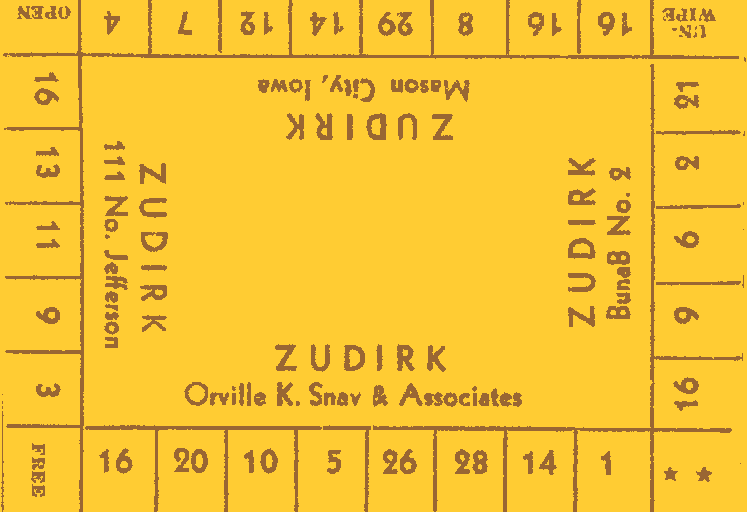
  • Zudirk, a small board game whose details I can't remember, but you were definitely not supposed to play it with strangers. In fact, you were clearly instructed: "Don't play Zudirk with strangers!!".... Here are the instructions and board.

  • The PMM Shield. Geared to those people who can't stand the morning, it protected them from the onslaught of the AM hours. It consisted of a black semi-circle which you were supposed to paste over one half of your clock face.

  • A record for those who liked to listen to records while watching TV. It was priced around $15, according to my Dad, and was completely silent on both sides. Mr. Crowder was once asked on a game show why it cost so much if it was only silence. Crowder defended the price well, saying that the production costs were tremendous. Imagine, he said, getting a full 40-piece orchestra into a studio, getting them all tuned up, and then asking them to remain silent for two 20 minute periods. Invariably, he went on, you'd be seven minutes into a take and someone's chair would squeak, or someone would cough,forcing you to start all over.

If you want testimonials about the BUNAB and other Orville K. Snav & Associates products, check here and here.

BTW, Trapdoor Spider still has her own BUNAB, and it still...um...does what it does....

:-)